Making Headway in Our Process
To shepherd the implementation of the FPH mission, we introduced four mechanisms in 2024 to ensure its delivery:
► The Integrated Management Framework which embeds sustainability and risk/opportunity assessment in key corporate functions
► The ESG Data Management Guidelines on data collection, analysis and reporting
► The ESG Data Management Platform that stores, consolidates and provides the initial ESG analytics
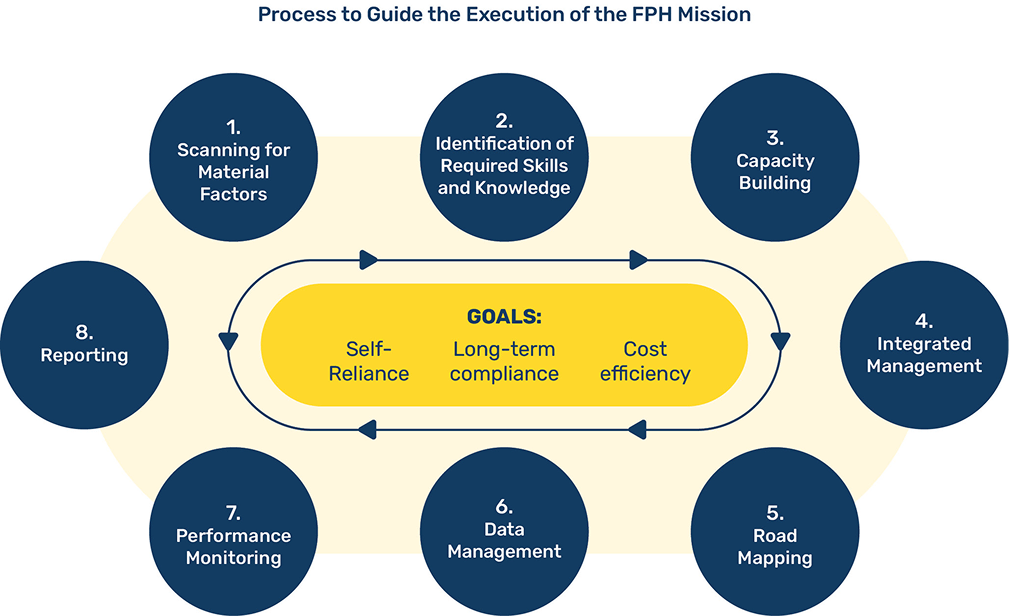
In 2024, we combined these mechanisms with our other ESG practices for the past years into one cohesive process to institutionalize how we execute our mission. This process assists our subsidiaries in achieving the following:
► self-sufficiency in skills for their ESG-related decision-making
► long-term compliance by embedding ESG requirements in regular functions
► elimination of external support and additional costs by building competency in ESG
Step 1: Material Factors
We regularly inventory and prioritize the financial and non-financial ESG factors that can potentially affect the execution of our mission. Among many considerations, we are focusing on two aspects: a) governance practices related to ESG policies, SEC regulations, and investors’ standards; b) any ESG-related threats and opportunities to our operations.
Step 2: Required Skills and Knowledge
We identify the knowledge and skills needed to address the material factors. Based on our learnings from training sessions since 2021 to the present, we use three criteria: a) support for regulatory compliance, b) good practices to address ESG issues, and c) ease of execution of the methodology proposed for adoption.
Step 3: Capability Building
Capability building activities are either special studies that are shared with the subsidiaries or training for re-skilling or upskilling. The objective of any learning session is to develop knowledge products such as plans, templates, or tools. With our shift in mission in 2020, we first paid attention to the SEC requirements and our climate pillars from 2021-2023. In 2024, we deepened our understanding of specific skills such as those of TCFD (climate scenario analysis, climate risks and opportunity assessment, risk scoring, and financial impact assessment) and Scope 3 GHG accounting.
Step 4: Integrated Management Approach
Since 2024, sustainability is being embedded in key corporate functions such as in corporate governance, strategic planning, risk management, and budget allocation. Integrated management will continue to be expanded to other responsibilities next year.
Step 5: Road Mapping
With the skills and knowledge acquired from capability building and with the key functional groups being integrated through the Integrated Management Approach, the subsidiaries were able to craft initial decarbonization and regeneration measures in 2023. By 2024, more definite measures and targets were established in varying degrees across the Group.
Step 6: Data Management
In 2024, we were able to fully use the ESG Data Management Guidelines which standardized the capture, analysis and storage of ESG data. These protocols were used in tandem with our digital ESG Data Management platform to increase the integrity of the data used for disclosures in this report and for other external communications.
Step 7: Performance Monitoring
There is a regular performance review of financial or non-financial or ESG operations by the Executive Committee at least twice a year during the Strategy and Synergies Planning (SSP) discussions which serve as a review session by senior leadership of all the subsidiaries’ business and ESG performance. To get the fundamentals right, in 2024 we revisited our subsidiaries’ “plumbing” (structure and processes) to check the fundamentals of their accuracy and efficiency in implementing the FPH mission. One-on-one sessions were held from June to December 2024. The activity included a review of the subsidiaries’ grasp of the mission, Technical Working Group structure, identification of their pentad stakeholders, and screening of material ESG indicators. This support to the subsidiaries is ongoing.
Step 8: Reporting
The Integrated Report is written in full compliance with the Philippine SEC rules and other international standards. Since the report is the primary source of financial and non-financial information of our stakeholders, a major feature of the 2024 report is a third party Limited ESG Data Assurance to improve its reliability to the users of the report.
Our Progress in Decarbonization
We are one with Andrew Winston, a global expert on sustainable business on his argument for climate action. He said, “Businesses and their leaders should act because they must realize we need to, have to and want to.”34 He explained that we need to act because of the worsening weather events in order to survive, we have to act because of the new waves of legal requirements and stakeholder expectations, and we must want to act as smart climate strategies can cut costs, reduce risks, boost revenues, and build brand value.
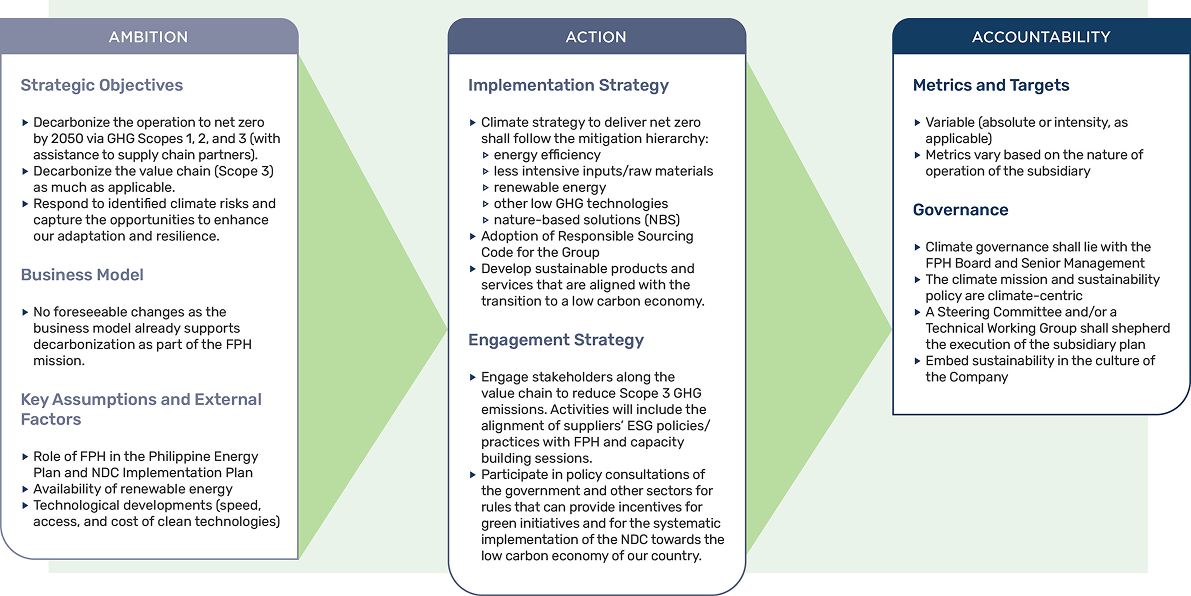
Below is our general climate transition plan referenced on the Transition Plan Taskforce (TPT) Disclosure Framework.35
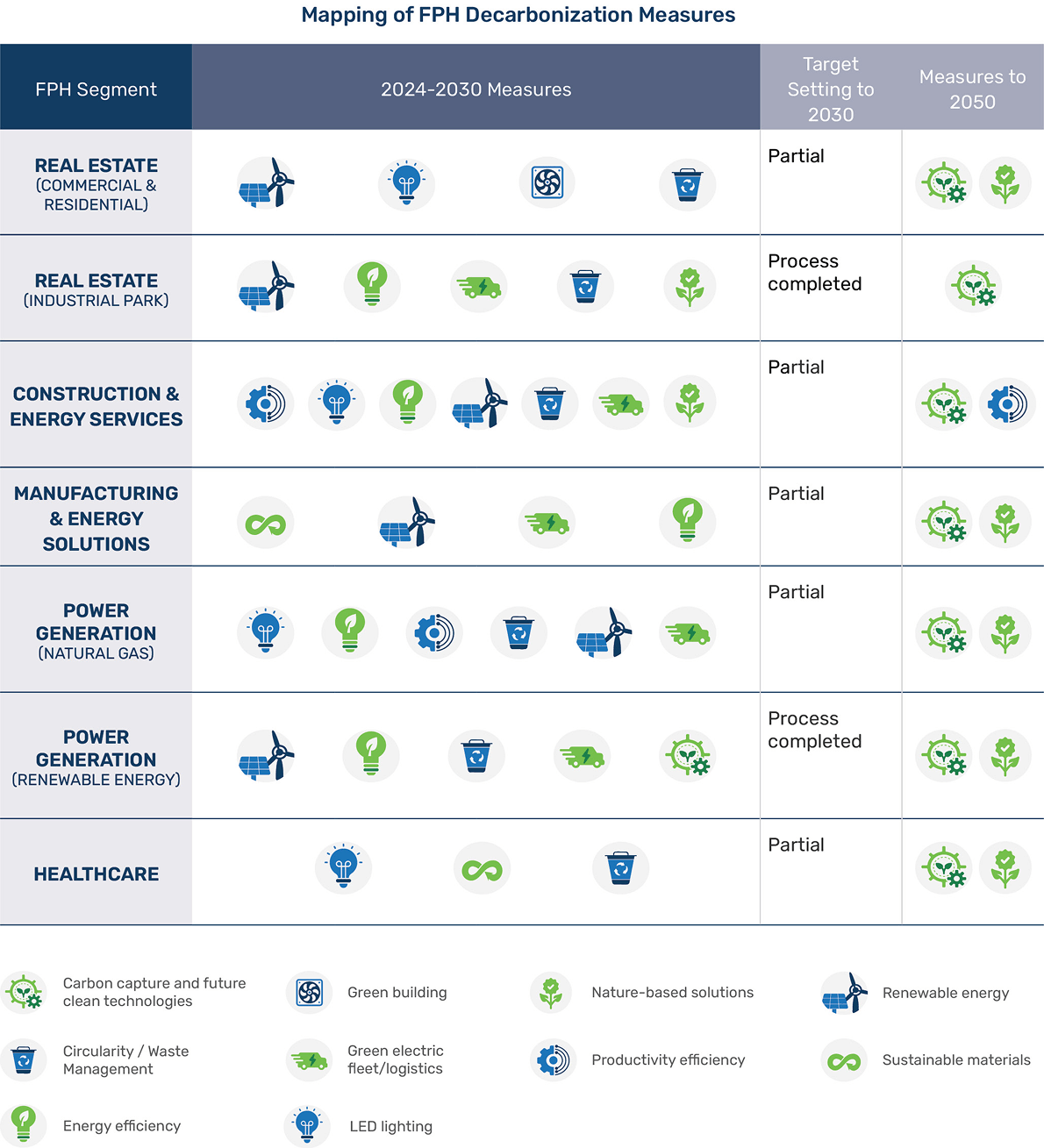
Status of Decarbonization Plans
Like many companies across the world that are constrained with the dearth of GHG removal technologies and limited financial resources, FPH is adopting the GHG mitigation hierarchy approach involving the adoption of the low hanging fruits or measures available now (e.g. energy conservation and efficiency, renewable energy, circularity, etc.). As summarized by Project Drawdown36 and as practiced by many organizations, we need to “step on the emergency brakes” to reduce the emissions as quickly as we can. While our foot is on the brake, we will continue to scan evolving clean technologies that are technically feasible and at the same time economically viable to lead us to net zero by 2050.
Even as clean technology is critical to meet the net zero goal, today the world does not have the needed carbon capture technologies. The last IPCC report (AR 6 Working Group III)37 discussed the challenges in the implementation of mitigation strategies in Section 3.6. These include technology risks, scaling, and cost. Another challenge cited in Section C.4.6 is the availability of appropriate geological storage for large scale fossil-based GHG emissions. For the non-power segment, Section C.5.2 reported that low to net zero GHG intensity for
primary industrial materials is at the pilot stage and if in near commercial stages, they are not yet established as the industry practice. Thus, we are piloting with the Department of Environment and Natural Resources on a Nature-based Solutions Project (NbS) to sequester the carbon emissions as a stop gap measure while scouting for the appropriate carbon removal technologies. The NbS pilot project will consider not only the volume of carbon that can be sequestered by the project but more importantly, the ecological parameters required to increase the resilience of the vegetation stands from extreme heat that we expect in the years to come.
From the list of decarbonization options screened in 2023, each subsidiary further analyzed the mitigation measures it will pursue up to 2030 while scanning the evolving clean technologies that will bring them to net zero by 2050. Thus, for now firm decarbonization measures up to 2030 were defined but we will continue to conduct our analysis for years beyond 2030. Our path on decarbonization was designed without compromising our role in energy security under the Philippine Energy Plan, and the delivery of our products and services to our customers.
Our Progress in Regeneration
In the context of our mission, regeneration means the restoration and healing of our climate changed planet and people. The FPH mission of decarbonization and regeneration is premised on the principle of the interconnectedness of nature and man. Nature is the whole physical world that includes man. Since man is nested in nature, man through his activities, like our businesses, constantly interacts with nature and influences the state of nature. Interaction with nature can be positive when we derive environmental services from it, or it can be negative if our activities harm nature.
Today, the World Economic Forum reported that the top four global risks for the next decade will be nature-related (extreme weather events, biodiversity loss and ecosystem collapse, critical changes in the earth system, and natural resources shortage)38. Because nature has no boundary, these top global risks are expected to impact the local environment and communities in the areas we operate. The problem may be global, but our actions must be local within our work sites and our areas of influence. This is our mindset in implementing our mission of regeneration. We must not only contribute to restore nature but also the communities in our localities.
Restoring Nature
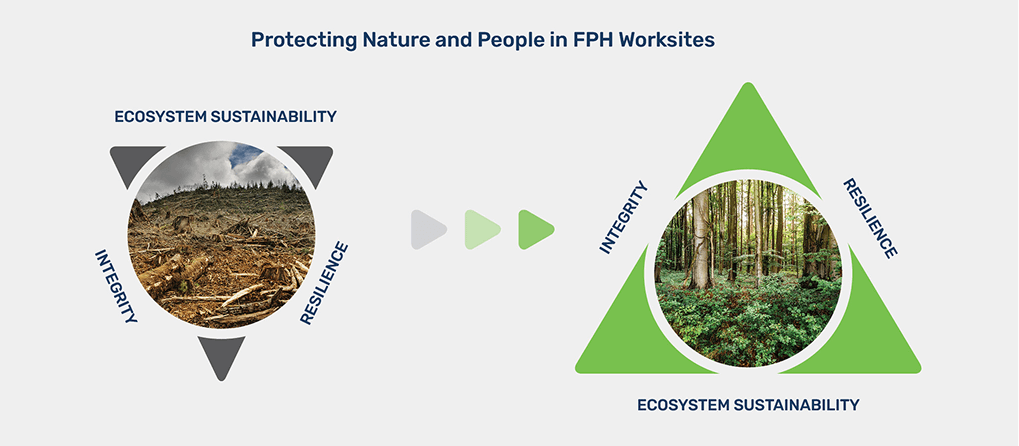
Nature in its normal state has three attributes: a) integrity or intactness of ecosystem structure, b) environmental sustainability as nature’s intact structure ensures its delivery of ecosystem services, and c) resilience as an intact structure and a fully functioning nature will have the capacity to adapt to external shocks or disturbances.
We need to restore nature from its sub-optimal to a better normal state by protecting its structural integrity and functions. A sub-optimal environment has a small natural foundation because of low integrity, sustainability, and resilience. In a sub-optimal state, man or business puts pressure on nature resulting in a fragmented environment delivering minimum functions. In the normal state, man or business puts little pressure on nature and nature fully delivers its ecosystem services. Our mission is to improve these three attributes in our work sites, reducing the pressure on nature and facilitating its recovery.
The initiatives of FPH in restoring nature in its project sites and areas of influence are in the form of land /aquatic habitat protection, revegetation, biodiversity conservation, alternative livelihoods to host communities, and engaging them on climate change awareness and action. The details of the FPH initiatives are found in the Natural Capital section of this report.
Restoring People
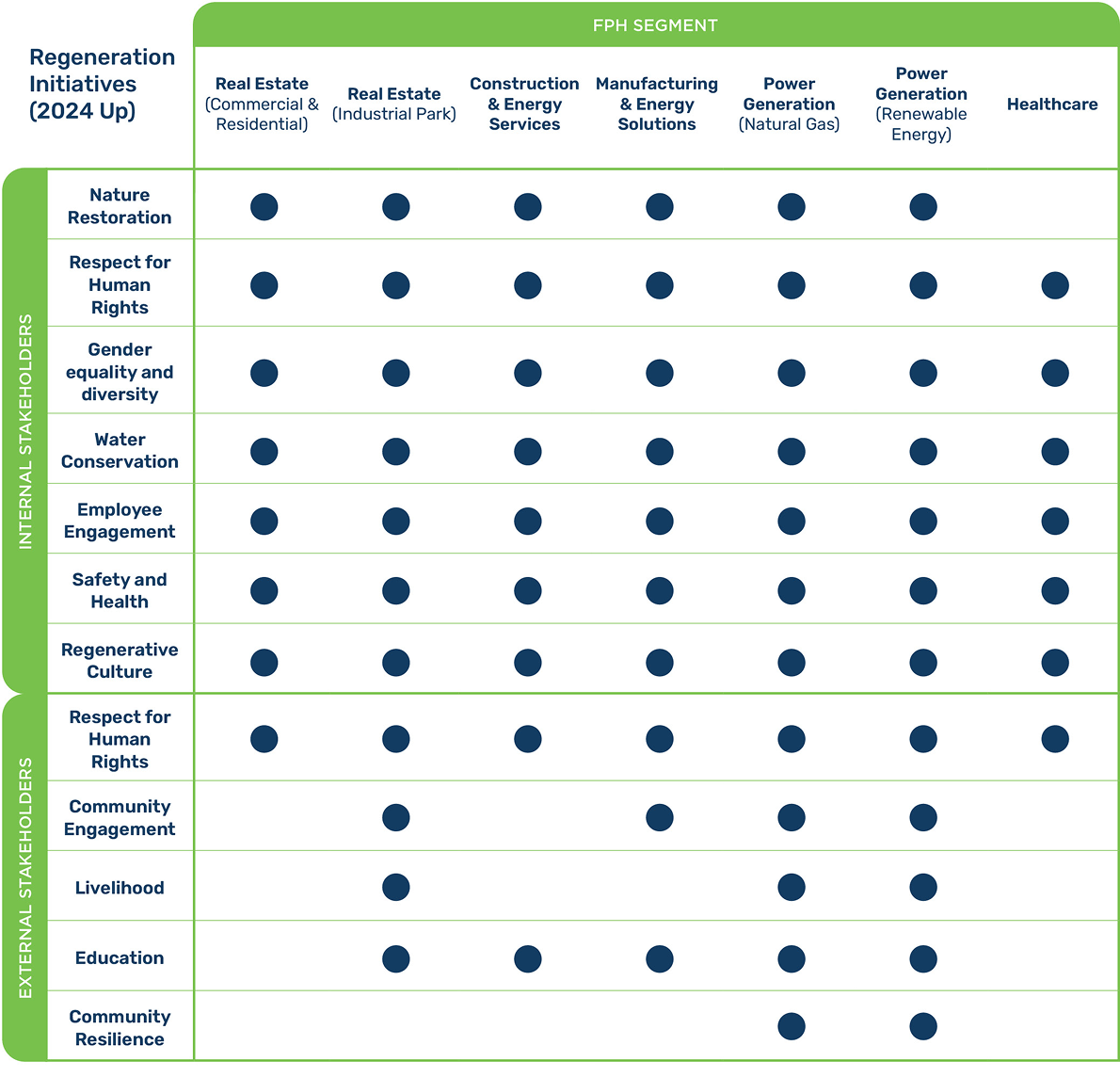
The other half of our mission is improving the well-being of our internal and external stakeholders. We are continuing the regeneration programs of the FPH business segments started in 2023 as shown below. These programs cover both internal and external stakeholders. Basic processes that capture employee experience and aid in culture development are critical regeneration elements, so they are found in all the business segments.
Support programs for sustainability safeguard policies such as: a) nature restoration, b) health and safety, and c) gender equality and diversity are also common across the Group. Programs for external stakeholders vary based on the nature of operation of the business segments, except for respect for human rights which applies to their whole value chain.
The operating units with defined host communities like the power companies, industrial park and our manufacturing and energy solutions subsidiary have additional initiatives beyond their business fence consisting of community engagement, education, livelihood support, and climate resilience. The health segment has an outreach program in non-host areas. The initiatives selected by the units were based on their available resources and skills.
By contributing to the restoration of nature’s integrity and people’s health, FPH creates a hospitable worksite where nature continues to provide the raw materials and physical protection we need for our operation, and the communities support and prosper with us as we grow our business in their area.
The decarbonization and regeneration measures we selected are aligned with our strategic objectives, as follows:
► Transformation of core models. In pursuit of our strategic objective to expand our scope and scale to catalyze decarbonization, the sustainable investments we chose to grow form part of our main decarbonization measures. These investments include renewable energy, which increased in scale and export of our green transformers. We also invest in adjacent businesses and other measures in energy solutions like energy audits and energy efficiency assessments.
▸ Diversification. Nature-based Solutions(NbS) is a frontier enterprise that we are studying with the government because of its massive decarbonization and regeneration potential.
▸ Capability building. The decarbonization and regeneration measures we are pursuing require technical skills that are supported by FPH training and our collaboration with the local government for enabling policies on clean energy technologies and NbS.
In implementing our strategic objectives, we can fulfill our commercial plans while meeting our mission of decarbonization and regeneration.

34 Winston, A. (2024). Why we need to, have to, want to act on climate change. Retrieved from https://andrewwinston.com/why-we-need-to-have-to-want-to-act-on-climate-change/
35 Sustainable Stock Exchanges Initiative (2023). Transition Plans Training Tool. Retrieved from https://sseinitiative.org/publication/transition-plans-tool/
36 Foley, J. (2022). Hitting the “emergency brake” on climate. Retrieved from https://drawdown.org/insights/hitting-the-%E2%80%9Cemergency-brake%E2%80%9D-on-climate/
37 IPCC, 2022: Summary for Policymakers [P.R. Shukla, J. Skea, A. Reisinger, R. Slade, R. Fradera, M. Pathak, A. Al Khourdajie, M. Belkacemi, R. van Diemen, A. Hasija, G. Lisboa, S. Luz, J. Malley, D. McCollum, S. Some, P. Vyas, (eds.)]. In: Climate Change 2022: Mitigation of Climate Change. Contribution of Working Group III to the Sixth Assessment Report of the Intergovernmental Panel on Climate Change [P.R. Shukla, J. Skea, R. Slade, A. Al Khourdajie, R. van Diemen, D. McCollum, M. Pathak, S. Some, P. Vyas, R. Fradera, M. Belkacemi, A. Hasija, G. Lisboa, S. Luz, J. Malley, (eds.)]. Cambridge University Press, Cambridge, UK and New York, NY, USA. doi: 10.1017/9781009157926.001
38 World Economic Forum (2025). Global Risks report 2025. Retrieved from https://www.weforum.org/publications/global-risks-report-2025/