
We must bear in mind that the ultimate goal is to solve the climate crisis that, by all accounts, is undeniably real and in urgent need of action.
Federico R. Lopez
Chairman and Chief Executive Officer
Dear Stakeholders,
Back in 2013, we witnessed first-hand as a company the destruction and devastation wrought by Typhoon Haiyan, the most powerful typhoon ever to make landfall. The storm made a direct hit on the Island of Leyte, severely damaging our largest geothermal power plants and disabling them for a few months. More than that, the death toll exceeded 6,300 but was likely higher as hundreds more were reported missing. For many months after, our more than 700+ employees simultaneously focused on rebuilding our plants to get them back to service as well as all the rescue and relief efforts for affected communities and residents around the province. That single typhoon upended the lives of thousands of people on the island for years and, despite help and efforts to rebuild, many never recovered what they lost. It became crystal clear to us even back then that we had just experienced the fury of being at ground zero of a climate-changed planet. Typhoon Haiyan was our rude wakeup call that it can no longer be “business as usual.” As a result, in 2016 we began building our energy portfolio around the theme of decarbonizing our electricity supplies and, by 2020, we had recast the FPH group’s mission statement to read “to forge collaborative pathways for a decarbonized and regenerative future.”
Global Weirding
Since that time, all parts of the world have witnessed their own versions of the “global weirding” of our weather – a term that captures the intensifying, unpredictable, and often contradictory pattern of climate extremes. 2024 was another horrendous year for the planet with the average annual temperature hitting 1.55°C above that of pre-industrial times. This makes the year the hottest it’s ever been in the last 125,000 years or so (surpassing 2023). The year also became a global demonstration of what happens when you have those higher temperatures that cause both extremely wet and insanely dry conditions. The planet will survive, but can humans and biodiversity as we know it adapt fast enough to what’s coming? And can we do what’s needed to mitigate emissions and even reverse these forces set in motion by our carbon-intensive economies?
In 2024, deadly wildfires continued to rage across several countries in South America and in California, causing billions in damage. Scorching heatwaves gripped India, Mexico, the Middle East, and Southeast Asia, with the Philippines recording a 55°C heat index last May 26. Southern Africa suffered its worst drought in a century, threatening food security for millions of people and affecting livestock. Ocean temperatures hit record highs, fueling stronger typhoons and floods such as those experienced in Eastern Spain, Thailand and Malaysia. Metro Manila’s flooding from Super Typhoon Carina broke records set by Ondoy in 2009, dumping 471mm of rain in 24 hours. Across the Philippines, we experienced six destructive typhoons between October and November, resulting in 160 deaths, widespread destruction of homes, significant damage to public infrastructure, and extensive damage to crops, livestock and fisheries. In each of these events we see families losing almost everything they have and, being uninsured, keep having to restart their lives over and over again in some vicious and cruel cycle of nature.
The rising global temperature is also having a profound and accelerating impact on the Cryosphere, which includes all of Earth’s frozen water. The melting of the world’s ice sheets is accelerating; from 1992 to 2020, the total amount of ice lost by Greenland and Antarctica was enough to raise sea level worldwide by an average of three-quarters of an inch or more. Glaciers, which hold 75 percent of Earth’s freshwater, are disappearing at twice the rate they did in 2000 and its meltwater has contributed to 21 percent of global sea level rise. At 1.5°C of warming, half of the world’s glaciers could “disappear” by the end of the century. Melting glaciers and ice sheets have already raised sea levels by around 21 to 24 centimeters since 1880. If all of Greenland’s ice melts, sea levels will rise by seven meters. If Antarctica follows, the increase will be a staggering 58 meters.
Permafrost, the frozen ground in Arctic regions, is thawing, releasing massive amounts of methane, that’s up to 86 times more potent than carbon dioxide depending on the timeframe. The Arctic tundra has now transitioned from a carbon sink to a carbon source due to increasing wildfire activities and warmer temperatures. This could trigger a climate time bomb, accelerating warming in an irreversible way.
The rising temperature is also causing the destruction of our ecosystems, threatening biodiversity and disrupting the marine food chain. We experienced the world’s fourth global coral bleaching event in April 2024 that was “the worst on record,” as it affected 77 percent of the world’s coral reef areas. At 1.5°C of global warming, between 70-90 percent of coral reefs will suffer. At 2°C, more than 99 percent of coral reefs could be lost. Up to one million animal and plant species are now threatened with extinction, many within decades. This would lead to the further disruption of ecosystems and food chains, impacting agriculture and food security.
It’s becoming more and more apparent each year that we are crossing several irreversible tipping points for the planet. The rapidly changing climate is not only bringing massive destruction in its wake, but also dispossessing millions of families of everything they have on a brutal and repeated basis. The effects are cascading, and further inaction will make it increasingly more difficult for life on this planet to adapt fast enough.
Global Headwinds and Challenges
Now recall how the world came together ten years ago in Paris and agreed to limit global warming to well below 2°C above pre-industrial levels, with an aspirational target of 1.5°C. More recently, the UN IPCC has underscored the urgency to target 1.5°C to avoid catastrophic climate impacts.Of course, COP29 last November brought some good news and culminated in several pivotal agreements aimed at intensifying global climate action, among them: the tripling of climate financing pledges from developed nations to USD300 billion annually, and the Loss and Damage Fund that is designed to provide financing to climate-vulnerable nations.
However, these wins for climate advocates were somewhat dampened by subsequent events that threaten progress on climate actions. Firstly, despite the dramatic 90 percent decline in renewable energy prices over the last 15 years, 2024 was also a record year for the global economy producing its energy from oil and coal, with hydrocarbons comprising 80 percent of the global primary energy mix, down only slightly from 85 percent in the 1990s.
Secondly, the United States, under its new administration, withdrew from the Paris Agreement, cutting climate funding and potentially stalling progress worldwide. This exit from the landmark agreement may be seen as an excuse by less committed companies to ease off their own efforts to curb their carbon emissions. Some oil and gas companies have announced plans to increase their output, reversing previous commitments to reduce fossil fuel production. Still, there are others that are advocating for stable, long-term climate policies to effectively address greenhouse gas (GHG) emissions. Other corporate leaders face the dilemma of aligning with policy shifts or adhering to their sustainability commitments.
Six major US banks have abandoned the Net Zero Banking Alliance, reducing decarbonization financing for many climate-vulnerable nations in Southeast Asia seeking investments and loans to build climate-resilient infrastructures. The US Securities and Exchange Commission has also introduced regulations that reduce funding for clean energy projects and has made it easier for companies to contest shareholder resolutions related to environmental, social, and governance (ESG) issues.
The global landscape of net-zero commitments has also experienced significant shifts, reflecting both progress and emerging challenges.
A substantial portion of the world’s largest corporations have pledged to achieve net-zero emissions by 2050. Notably, 65 percent of the annual revenue of the world’s largest 2,000 companies is now covered by a net-zero target. However, a recent analysis reveals that only 16 percent of these companies are currently on track to meet their net-zero goals, with nearly half witnessing an increase in emissions.
And while the number of entities pledging net-zero emissions has increased, a significant portion still lacks concrete targets. An annual survey by Net Zero Tracker indicates that over 40 percent of major companies, cities, and regions have yet to set targets for reducing greenhouse gas emissions.
The 2023 Global Stocktake (GST), a core component of the Paris Agreement that assesses each country’s progress on climate action and encourages them to augment their climate goals, highlighted that the world is not on track on limiting global warming to 1.5°C. In response, countries are required to submit updated NDCs by February 2025, delineating their enhanced commitments to emission reductions and climate resilience. However, as of the February 10 deadline, only 13 out of 195 nations have complied, potentially impeding global mitigation efforts.
For the Philippines, despite the DOE’s Renewable Energy Roadmap and the moratorium on new coal plants in October 2020, we continue to be heavily reliant on coal for our energy needs, accounting for 62 percent of the electricity generated in 2024. However, even as we speak interests are at work to expand coal plants which will heighten our electricity grid’s reliance on even more coal and increase the carbon emissions per kWh of our electricity grid. The justification being that coal today is cheaper. If the grid moves in the wrong direction it will nullify the decarbonizing effects of electrification. (Electric Vehicles, for example, being effectively powered by even more coal.)
In the last few years, I’ve spoken about what many believe are the three necessary phases to “solve the climate crisis”:
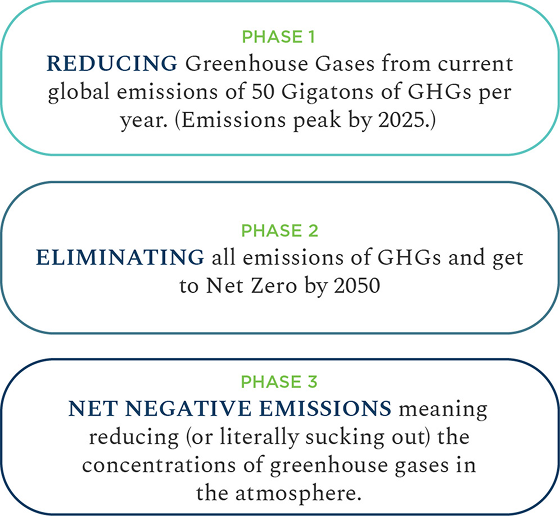
Unfortunately, much of the world’s actions are still primarily just focused on Phase 1 reductions, and emissions peaking by 2025 is certainly not about to happen.
Sometimes we visualize technology breakthroughs and the possibility that the AI revolution can help solve the world’s most intractable and wicked problems. This is exciting as we acquire new and more powerful tools that enable us to go beyond historical human limits. But this is also a double-edged sword as fueling this AI revolution will now put even more strain on our power grids and the demands imposed by the energy transition to net zero. Prior to considerations for AI, the expectation was that we would need five times more electricity and ten times more clean electricity by 2050 to shepherd us through the three phases of decarbonization. Just over the last two to three years there’s been a growing recognition of the power requirements needed for the AI revolution currently projected to require an additional 45,000 MW between now and 2030. This is adding the equivalent of what a major economy like France or Germany uses today. The International Energy Agency also noted that the extreme heat of 2024 also increased emissions and energy use considerably due to higher needs for air conditioning and cooling. This underscores yet another deadly feedback loop that will make solving the climate crisis even more challenging.
The prospect of cheaper, more affordable 24/7 renewable power, batteries, EVs have been coming down fast over the last decades thanks in large part to China, economies of scale and globalization. All these may encounter headwinds as the world deglobalizes and bifurcates further. We will need to watch this space closely but in their drive for cheaper and cleaner power many data center developers are now looking toward nuclear power. Hopefully the smaller, safer technologies (Small and Micro Modular Reactors) develop fast enough but as of now are still five to ten years away from commerciality.
Admittedly, when we see the compressed time frame of 25 years we have left to achieve all three phases of decarbonizing our economies, our lives, and the planet before we tip into irreversibility, it all can feel extremely daunting.
Staying The Course
Given all these headwinds and challenges, many of you may ask whether our group’s Mission, Vision, and strategic directions are still realistic? Our answer to this is a resounding YES, even more so! We have always maintained that the forces of climate change are not linear. We have used the phrase “gradually, then suddenly” to describe how it will progress and today’s almost exponential acceleration of climate shocks can no longer be ignored. Likewise, the socio-political and economic forces that will transform the way we live and work on this planet are not, and will also never be linear. But the direction and scale of the natural forces unleashed is undeniable and so must be the scale and intensity of our actions. I’ll say it again: this is the greatest transition in the history of mankind. We are thus continuing to shape our platform of businesses to help shepherd our country’s energy use toward staying relevant as well as profitable in this rapidly decarbonizing world.Thank you for your continued trust and support as we stay the course.